
Last updated: 1 November 2026 · Written by Axel
What expenses can a limited company claim? Any cost the company pays wholly and exclusively for the purposes of its trade: materials, small tools, van running costs, insurance, software, training, subcontractors and a share of home working costs. Each allowable pound comes off the profit the company pays Corporation Tax on, which for a small company means 19p back on every pound. What you cannot claim is just as important: client entertaining, fines, everyday clothing, personal costs and depreciation. Here is the full list, the gotchas, and how it all flows through to your CT600.
The one rule behind every expense
Every claim comes back to one test. Under section 54 of the Corporation Tax Act 2009, as HMRC's Business Income Manual at BIM37000 puts it, expenditure "cannot be deducted in computing trading profits unless it is incurred wholly and exclusively for the purposes of the trade".
In practice, ask yourself: would the company have spent this money if it did not run the business? If the honest answer is no, it is usually allowable. If the cost also serves a personal purpose, you are in tricky territory, which we cover below.
Two related rules trip people up:
- Capital items are not expenses. A van or a big piece of kit you keep for years is not deducted like a box of screws. It gets capital allowances instead.
- Dividends are not expenses. They are paid out of profit after Corporation Tax. A director's salary is a cost to the company; the dividend is not. Our post on director salary vs dividends covers the split.
Limited company expenses list: what you can claim
For a tradesman or small business owner, the usual allowable expenses are:
- Materials and stock. Timber, cable, pipe, paint, parts and anything you buy to use on jobs or resell.
- Small tools and consumables. Drill bits, blades, hand tools, PPE.
- Van running costs. Fuel, insurance, servicing, repairs, MOT, road tax, parking on jobs, and the interest part of finance payments on a company-owned van (the capital part goes through capital allowances).
- Insurance. Public liability, professional indemnity, tools and contents cover.
- Software and subscriptions. Accounting and job management software, phone contracts in the company's name, trade body memberships.
- Training. Courses that keep your existing trade skills up to date, such as a refresher or a new certification in the work you already do.
- Subcontractors. Payments to other trades who work on your jobs.
- Staff costs. Wages, employer pension contributions, and the director's own salary if paid through payroll.
- Staff entertaining. The Christmas do counts. HMRC's guidance on staff entertainment at BIM45034 says it is allowable, as long as it is not incidental to entertaining customers.
- Protective clothing and uniforms. Steel toe caps, hi-vis and branded workwear are fine. HMRC allows a deduction for "protective clothing and uniforms".
- Small branded gifts. A pen or a mug with your logo on it can be allowable if the gift carries a conspicuous advert for the business, costs no more than £50 per recipient in the accounting period, and is not food, drink, tobacco or a voucher.
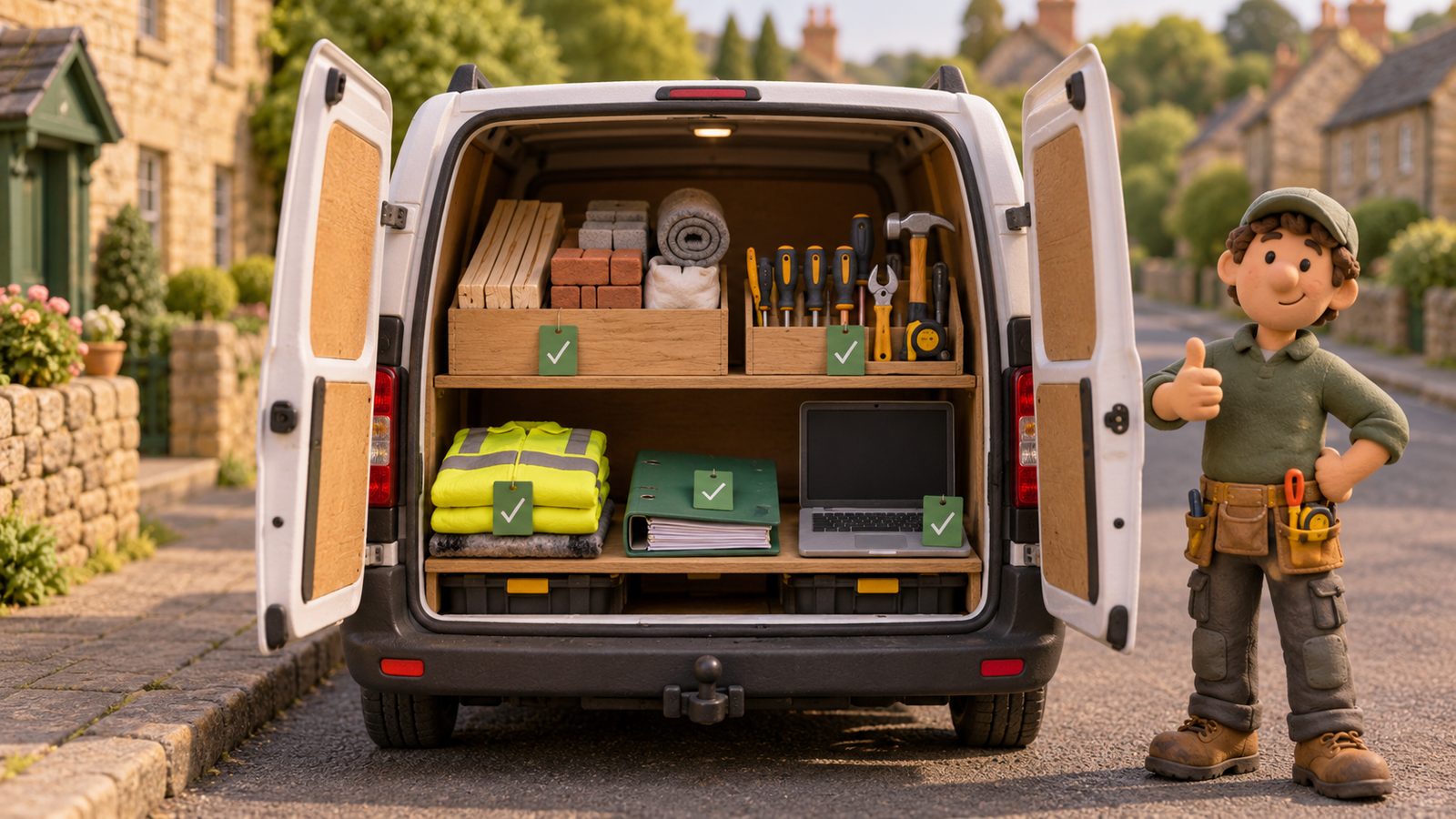
Big kit: capital allowances, not expenses
Can a limited company claim van and tool costs? Yes, but a van goes through capital allowances rather than the expenses line. The good news is that the Annual Investment Allowance usually gives 100% relief in the year of purchase. GOV.UK says the AIA amount is £1 million per accounting period, and business cars are excluded. Vans are not treated as cars for capital allowances, per GOV.UK's business cars guidance, so vans, tools and equipment qualify. Our guide to capital allowances on a van and tools walks through it.
Home working and mileage
If you run the business from home, the company can pay you a flat £6 a week (or £26 a month if you are paid monthly) tax free for extra household costs, provided you work from home under an agreed arrangement and do so regularly. That is HMRC's homeworking exemption. Bigger claims need to reflect your actual extra costs.
If you use your own car or van for business trips, the company can pay you the approved mileage rates (as an employee of the company, which a working director normally is): 55p a mile for the first 10,000 miles from 6 April 2026 (45p before), then 25p a mile after that.
Disallowable expenses for Corporation Tax
| Cost | Allowable? | Why |
|---|---|---|
| Materials, small tools, consumables | Yes | Wholly for the trade |
| Van fuel, insurance, repairs | Yes | Running costs of a business vehicle |
| Van or large equipment purchase | Via capital allowances | Capital item, AIA usually gives 100% |
| Staff Christmas party | Yes | Staff entertaining exception |
| Taking a client for dinner | No | Business entertainment is barred |
| Parking or speeding fines | No | Penalties for breaking the law |
| Everyday clothes worn for work | No | Part of a normal wardrobe |
| Branded workwear, PPE | Yes | Protective clothing and uniforms |
| Depreciation in the accounts | No | Replaced by capital allowances |
| Personal shopping, family phone bills | No | Not wholly for the business |
A few of these deserve a sentence each:
- Client entertaining. HMRC is blunt: "expenditure on business entertainment or gifts is not allowable as a deduction against profits", subject to the narrow exceptions above. The pub lunch with a builder who sends you work is not deductible, however good for business it was.
- Fines. HMRC says "you should disallow any penalty for infraction of the law". A parking ticket picked up on a job is still a fine.
- Clothing. If it could be part of an everyday wardrobe, it fails, even if you only ever wear it on site. Jeans and a plain fleece are out; a logo'd polo is in.
- Depreciation. Your accounts will depreciate the van, but HMRC's capital allowances manual says capital allowances "take the place of depreciation charged in the commercial accounts, which is not normally deductible for tax purposes". So depreciation is added back in the tax computation, and capital allowances are deducted instead.
The gotchas that cost money
Mixed-use costs
Some costs are partly business and partly personal: a phone, broadband, a car used for both. If you can identify a business part, HMRC says that part "should not be disallowed on the ground that the entire expense is not laid out" for the business. Work out a fair percentage, write down how, and stick to it until things change. What does not work is a cost with a genuine double purpose, such as a holiday with a trade show tagged on.
Expenses you paid personally
It happens all the time: you buy materials on your personal card because the company card is at home. That is fine. Either the company repays you, or the amount goes in your favour on the director's loan account. GOV.UK is clear that an expense repayment is not a director's loan. Where it goes wrong is the other way round: personal spending on the company card, which puts you in debt to the company and can trigger the s455 charge. See director's loans and the s455 tax charge.
Receipts and records
No receipt, no claim, in practice. The company must keep records of "all money received and spent" and keep them for 6 years from the end of the last financial year they relate to, per GOV.UK's guide to company and accounting records. A photo of the receipt saved the same day beats a carrier bag of faded till slips in January.
How expenses reduce your Corporation Tax on the CT600
Expenses work in two steps. First they go through your accounts, reducing profit. Then the tax computation adjusts that profit: disallowable items are added back, capital allowances are taken off, and the result is the taxable profit that goes on the CT600.
Corporation Tax is 19% on profits of £50,000 or less (the small profits rate) and 25% above £250,000, with marginal relief in between, per GOV.UK's Corporation Tax rates page.
A worked example: a one-director electrical company with £80,000 of sales, no associated companies and a 12-month accounting period (so the full £50,000 small profits limit applies).
| Amount | |
|---|---|
| Sales | £80,000 |
| Allowable costs (materials, van running, insurance, software, subcontractors) | -£30,000 |
| Client dinners | -£600 |
| Fines | -£150 |
| Depreciation on the van | -£2,000 |
| Profit in the accounts | £47,250 |
| Add back client dinners, fines and depreciation | +£2,750 |
| Less AIA on £3,000 of new tools | -£3,000 |
| Taxable profit on the CT600 | £47,000 |
| Corporation Tax at 19% | £8,930 |
Notice two things. The disallowable costs did reduce the accounts profit, but the computation put them straight back. And if the company had lost £2,000 of receipts for genuine materials, taxable profit would be £2,000 higher and the bill £380 bigger. Every lost receipt costs 19p in the pound.
Above £50,000 of profit marginal relief kicks in and the sums change, so if you are near that line, run the numbers carefully. For the filing process itself, see how to file your CT600 yourself.
What to do before your year end
- Gather every receipt and invoice for the accounting period, including the ones on your personal card.
- Sort them into allowable, disallowable and capital (vans, big tools, equipment).
- Put a fair business percentage on mixed-use costs and note how you worked it out.
- Record personal-card purchases on the director's loan account in your favour.
- Total up capital items for the AIA and add back depreciation in the computation.
- If you have property, shares in other companies, overseas income or anything you are not sure is allowable, take it to your own accountant. Getting a grey-area expense wrong costs more than the advice.

Quick answers
Frequently Asked Questions
01Can a limited company claim the cost of a van?
Yes. A van is not a car for capital allowances, so it usually qualifies for the Annual Investment Allowance and the full cost can come off profit in the year you bought it. Running costs like fuel, insurance and repairs are ordinary allowable expenses.
02Can my company claim for taking a client out for lunch?
No. Business entertainment is not allowable for Corporation Tax, whatever the commercial reason. Staff entertaining is the main exception, as long as it is not incidental to entertaining customers.
03Can I claim work clothes through my limited company?
Only protective clothing and uniforms, such as PPE and branded workwear. Ordinary clothes that could be part of an everyday wardrobe are not allowable, even if you only wear them for work.
04What happens if I pay a business expense with my own money?
The company can repay you, or the amount can be credited to your director's loan account so the company owes you. Expense repayments are not treated as a director's loan, so there is no tax charge on getting your own money back.
05Is depreciation an allowable expense?
No. Depreciation is added back in the tax computation and capital allowances are claimed instead. For most small companies the Annual Investment Allowance gives full relief in the year of purchase anyway.
Once your expenses are sorted and you know your profit, the filing itself is the easy part. If your company is a simple micro-entity, A.X.E.L Filing files your micro-entity accounts and CT600 to Companies House and HMRC with your own Government Gateway login, £49 for both.
A.X.E.L Filing
Accounts and CT600, filed in one sitting.
Prepare your accounts and Corporation Tax return with the tax worked out as you type, next to your own Self Assessment, and let your AI run the what-ifs. Then file to Companies House and HMRC yourself. No accountant fees, no subscription.
£20 for a dormant company
Records in a mess? See what you need, and let your AI do the sorting →